
PRODUCT COMPARISON · 10 MINUTE READ
Bar LED Grow Lights vs. Quantum Board Panels: Which Is Better for Commercial Cultivation?
Compare Bar LED grow lights and quantum board panels for commercial cultivation. Review light layout, power, dimming, logistics, and buying criteria.
01 · DECISION FRAMEWORK
Compare the project, not the shape
Bar LED or quantum board is one of the most common commercial lighting questions. The correct answer depends on canopy geometry, mounting height, project scale, electrical plan, desired control method, and the technical documents available for the exact fixture. Neither form factor is automatically right for every crop room or greenhouse.
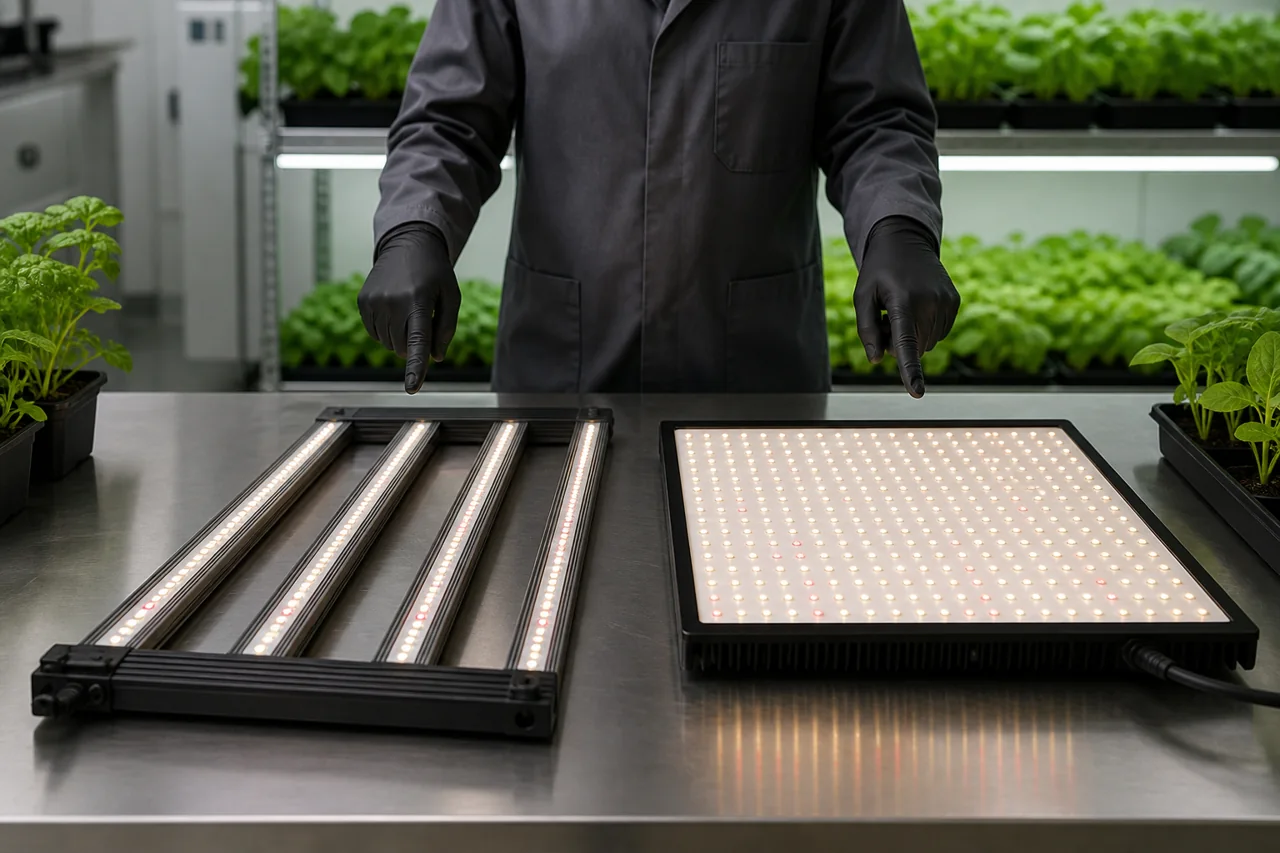
A quantum board is generally a flat panel with LEDs distributed over a board-like surface. A Bar LED fixture uses multiple linear LED bars arranged across a frame. The form factor affects fixture dimensions, weight distribution, packing, handling, mounting, access around the fixture, and the geometry used in a lighting layout.
The practical purchasing question is not which fixture looks more advanced. It is which geometry, output range, control method, and evidence package fit the proposed canopy. Start with crop, growing area, aisle arrangement, ceiling clearance, expected power density, facility voltage, and service requirements.
02 · CANOPY PLANNING
Review light distribution using the right evidence
Fixture geometry influences how a lighting layout is planned, but it does not establish uniformity by itself. Rigid-bar and T8-style fixtures can suit linear shelf and rack layouts; quantum-board configurations may suit other indoor canopy layouts. The useful comparison is the documented distribution of the exact fixture in the proposed arrangement.
Ask for PPFD or photometric information that states the fixture model, power setting, mounting height, spacing and measurement conditions. This gives the project team a meaningful basis for comparing a compact fixture, a linear fixture and a panel-style fixture rather than relying on appearance or a generic coverage claim.
Check canopy clearance, airflow, service access, electrical routing and dimming requirements at the same time. A configuration that fits a drawing may still be unsuitable if its mounting or maintenance requirements do not fit the operating environment.
A PPFD number is useful only when the model, mounting height, fixture spacing, and power setting match the proposed installation.
03 · ELECTRICAL AND CONTROL
Compare electrical fit and controls before installation
Control requirements should be confirmed for the exact model, not assumed from a fixture format. The current catalogue lists timer, dimming and memory-cycle functions on several compact and bar models; the quantum-board range lists manual dimming, with selected configurations listing a network serial port.
For a commercial project, define the intended control zones, electrical supply, cable routes, operator access and commissioning process before quotation. Ask the supplier to identify the current compatible controller, dimming method and installation requirements for the selected configuration.
Controls are useful only when they are documented, wired, commissioned and handed over correctly. Keep the approved configuration, wiring information and operator instructions with the project file.
NEXT STEP
Comparing Bar LED and quantum-panel models?
Share your canopy size, mounting height, voltage, crop, and required control method for a targeted product review.
Ask for Product Catalog →04 · PROCUREMENT DETAIL
Check logistics, spectrum, and specification control
A fixture comparison should end with delivery and acceptance checks. Confirm the exact ordered model, input voltage, spectrum configuration where applicable, control accessories, labels, mounting hardware, packing requirements and documents before production begins.
During factory testing and shipment inspection, compare the approved configuration with the product labels, drivers where used, cable routing, dimming response, accessories, carton marks, quantities and packing list. This links the lighting comparison to the goods that actually leave the factory.
FAQ
Frequently asked questions
CONCLUSION
Move from a general comparison to a verified project review
The next step is to match the chosen product family to the crop, canopy, facility, electrical system, and installation plan. Weltesim can provide current model documentation and route commercial requests to the appropriate lighting discussion.
Ready to discuss your lighting project?
Share your product requirements, growing environment, and project timeline.
Get a Quote →