
GREENHOUSE LIGHTING GUIDE · 11 MINUTE READ
How to Plan Supplemental LED Lighting for a Greenhouse
Plan greenhouse supplemental LED lighting with DLI, PPFD, controls, mounting, electrical preparation, testing, and shipment-inspection guidance.
01 · GREENHOUSE CONTEXT
Define the role of supplemental lighting
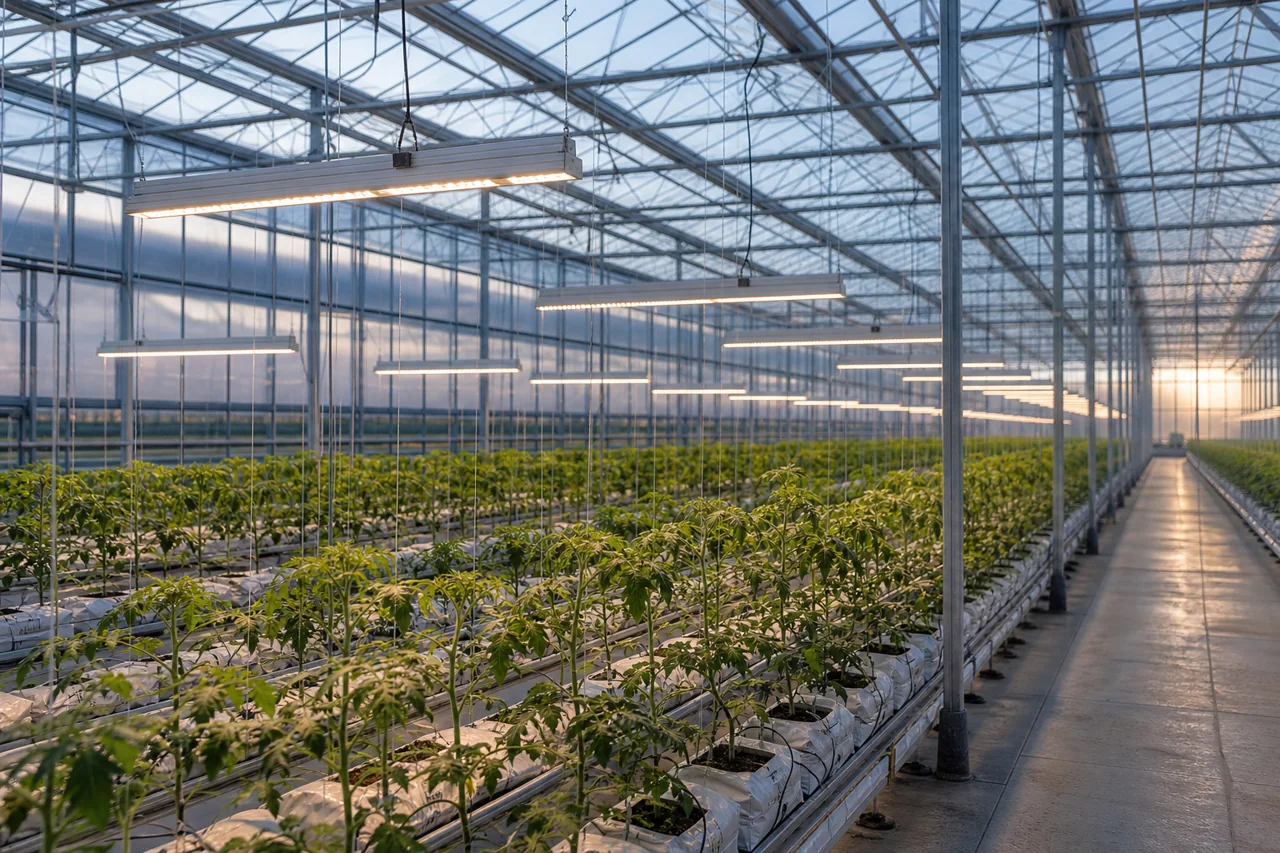
Greenhouse supplemental lighting is not simply an indoor fixture plan installed under glass. A greenhouse already receives sunlight, and the light reaching the canopy changes with season, location, weather, glazing, structure, shading systems, crop density, and time of day. Electric lighting should be planned around the light deficit and production objective.
Supplemental lighting may help raise light levels during low-light periods, support production consistency across seasons, extend a photoperiod, reduce the effect of short winter days, or support selected propagation and finishing zones. The goal should be documented before a fixture is selected.
Lighting remains one part of the production system. Crop response also depends on temperature, humidity, irrigation, nutrition, CO₂ strategy, cultivar, plant density, and crop stage. A lighting supplier can provide product and layout information; crop targets should be set with the grower’s production team or qualified crop advisor.
02 · LIGHT DEFICIT
Plan around DLI and PPFD—not a fixed number of fixture hours
Daily Light Integral, or DLI, represents the total photosynthetic light received by the crop over a day. It provides a practical framework because greenhouse sunlight and electric light can be considered together. A supplemental-lighting plan needs the desired crop DLI, average seasonal natural light, greenhouse transmission losses, and supplemental PPFD at canopy height.
A simplified relationship is Supplemental DLI = supplemental PPFD × 0.0036 × operating hours. For illustration, 200 μmol/m²/s running for 12 hours provides approximately 8.6 mol/m²/day of supplemental DLI. This is a planning calculation, not a universal crop setting. The program must account for the crop’s photoperiod and actual sunlight contribution.
Before requesting a final quote, collect crop and production calendar information, greenhouse dimensions, gutter and mounting height, glazing and shading details, truss layout, production-row arrangement, available voltage, distribution-panel location, and preferred control method. A fixture quote without these inputs can support budgeting, but it is not yet an installation plan.
Use current site measurements and crop guidance where possible. Do not copy a runtime from another greenhouse without accounting for sunlight, structure, crop, and season.
03 · PROJECT REQUEST
Build an installation-ready lighting brief
A strong request to a supplier identifies the productive growing area, rather than only the building footprint. Include a drawing or dimensioned layout whenever possible. Ask the supplier to clarify model, quantity, mounting height, spacing, PPFD method or distribution document, power setting, input voltage, control method, connected load, accessories, installation requirements and packing details.
The current Weltesim catalogue includes quantum-board configurations from 100 W to 600 W, together with fixed T8-style and rigid-bar formats. The correct purchasing boundary is to request the current approved technical package for the specific greenhouse configuration before committing; a series name or a legacy catalogue figure is not enough for final selection.
If a project needs dimming, environmental protection or a particular input voltage, include those requirements in the brief and confirm them against the exact selected model. Suitability still depends on actual humidity, cleaning exposure, electrical design, mounting system and the final application review.
NEXT STEP
Need a greenhouse lighting brief that can be quoted accurately?
Send your crop, greenhouse drawing, target season, available voltage, mounting height, and control preference.
Send Your Requirements →04 · INSTALLATION AND HANDOVER
Prepare controls, commissioning, and shipment inspection
A basic timer can be useful, but sunlight changes throughout the day. A greenhouse control plan may use scheduled morning and evening operation, photoperiod extension, light-level thresholds, or zoned dimming. If 0–10 V control is planned, define the fixture groups, controller compatibility, cable routes, commissioning level, operator override, and handover record before delivery.
Installation preparation should include structural mounting points, clearance from curtains, vents, irrigation lines, and crop-handling equipment, circuit capacity, disconnects, control cables, grounding, and local code review. The electrician should work from approved drawings and the current fixture manual, not a generic product image.
Before energizing all zones, verify fixture model and voltage, hanging hardware, cable strain relief, circuit labeling, zone response, dimming function, controller settings, manual override, and operator training. Factory testing and shipment inspection should verify the same approved configuration: model, voltage, labels, power-on function, dimming where included, accessories, carton count, packing condition, and final documentation.
- Confirm truss mounting and access for maintenance
- Match input voltage, circuits, connectors, and control wiring
- Verify control zones and dimming during commissioning
- Inspect model, labels, accessories, cartons, and documents before shipment
- Retain inspection records with the project file
FAQ
Frequently asked questions
CONCLUSION
Move from a general comparison to a verified project review
The next step is to match the chosen product family to the crop, canopy, facility, electrical system, and installation plan. Weltesim can provide current model documentation and route commercial requests to the appropriate lighting discussion.
Ready to discuss your lighting project?
Share your product requirements, growing environment, and project timeline.
Get a Quote →