
CUT FLOWERS & LIGHT SPECTRUM · 10 MINUTE READ
How to Plan LED Grow Light Spectrum for Commercial Cut Flowers
A practical guide to planning blue, red, and far-red LED spectrum for commercial cut flowers—covering crop stages, trial design, fixture selection, and supplier documentation.
01 · CUT-FLOWER PRODUCTION
Start with the crop and production outcome—not a universal spectrum recipe
Commercial flower growers rarely need light for only one reason. A lighting program may support propagation, vegetative development, photoperiod management, flower initiation, finishing, crop timing, or seasonal consistency. The right starting point is therefore the crop, cultivar, production stage, and marketable outcome—not a generic claim that one spectrum is best.
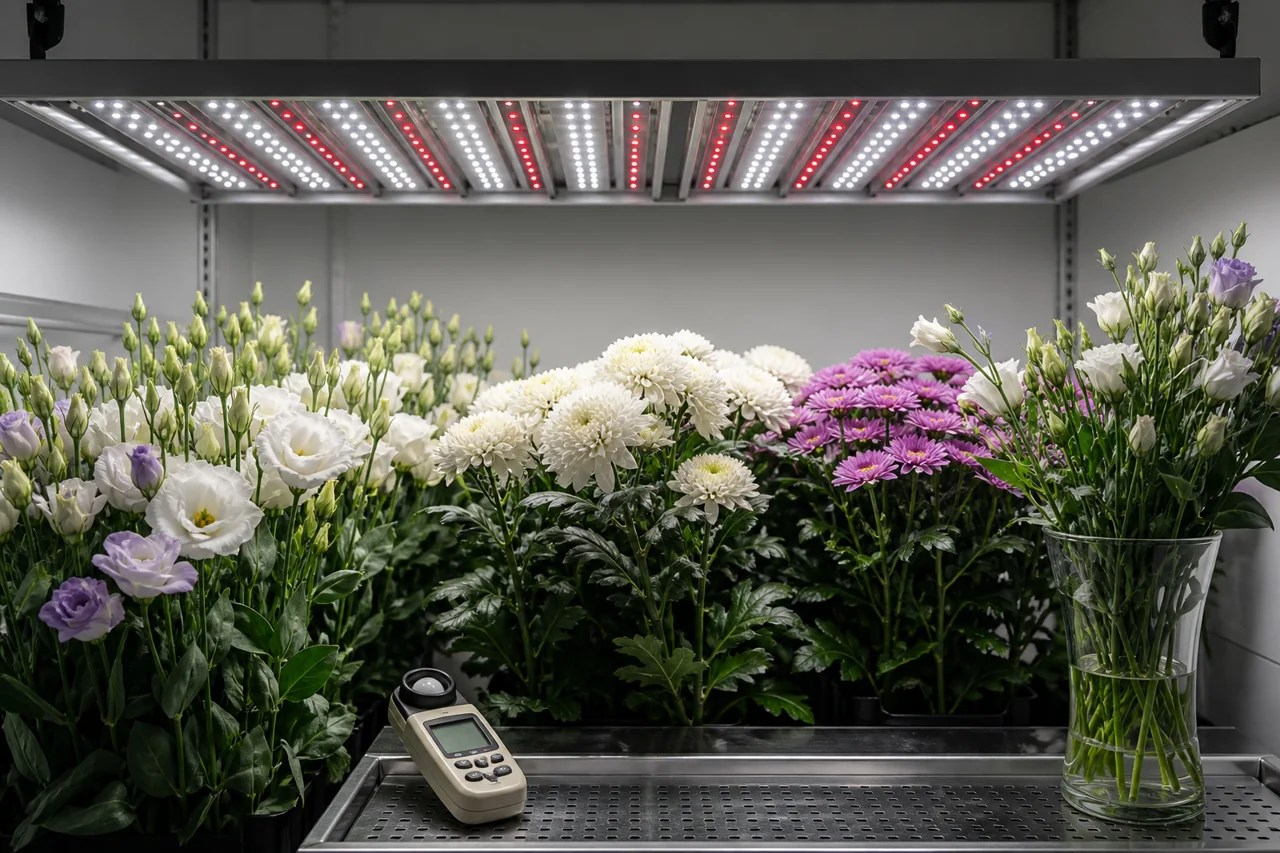
The supplied flower-lighting reference identifies dahlia, gypsophila, solidago, scabiosa, chrysanthemum, aster, and matricaria as crops where blue light, red light, or both may be relevant at particular stages. That is a useful crop list for a project discussion. It is not a fixed spectrum prescription: cultivar response, daylight, temperature, plant density, photoperiod, and total daily light all influence the final result.
For a commercial program, write the desired outcome in observable terms. Examples include a more consistent propagation schedule, a defined flowering window, compact vegetative growth, stronger stems, a target harvest date, or a specified production zone operating through a low-light season. Then connect that outcome to a lighting plan the grower can measure and revise.
This approach also prevents a common procurement error: selecting a fixture because it contains a named wavelength before confirming its photon output, distribution, controls, mounting geometry, and evidence package. Spectrum is one part of the system; the canopy receives the result of spectrum, PPFD, runtime, spacing, and the rest of the crop environment.
- Crop species, cultivar, and crop stage
- Propagation, vegetative, flower-initiation, or finishing objective
- Greenhouse sunlight contribution or indoor-room baseline
- Target photoperiod, operating season, and harvest schedule
- Canopy height, plant density, and available mounting height
02 · SPECTRUM LANGUAGE
Use blue, red, and far-red language carefully
Blue light is commonly included in horticultural LED fixtures and is relevant to plant morphology and photosynthetic responses. In flower programs, growers may evaluate it alongside total photon delivery when they are managing vegetative development, leaf characteristics, plant structure, or crop timing. The practical question is not whether blue light is present, but whether the selected fixture and operating plan suit the crop and stage being evaluated.
Red light is also a central part of many horticultural spectra because it contributes to photosynthetic photon delivery and can be relevant to photomorphogenic responses. The reference document notes red light as a consideration for flowering crops such as solidago. A commercial buyer should still ask for the spectral distribution of the exact configuration and confirm how its operating schedule supports the intended production objective.
The term infrared is often used loosely in grow-light discussions. In horticulture, a supplier may mean far-red radiation, commonly discussed around 700–750 nm, rather than thermal infrared. These are not interchangeable terms. Before comparing products, request a current spectrum chart and ask the supplier to state whether a far-red channel is included, its approximate peak or range, how it is controlled, and whether it is fixed or independently dimmable.
A fixture with blue, red, and far-red components does not automatically improve every flower crop. Higher intensity, longer runtime, or a spectrum change can also alter plant architecture, flowering behavior, energy use, and heat load. Treat the spectrum as a controlled production input and confirm its effect in the grower’s own environment.
For a purchase decision, confirm whether “infrared” means far-red spectral output or heat-related infrared. Ask for the exact spectrum and control method for the ordered model.
03 · ON-SITE LEARNING
Turn a spectrum idea into a measured commercial trial
A small, disciplined trial is more useful than copying another grower’s recipe. Choose a representative production zone and keep as many non-light variables stable as practical: cultivar, planting date, irrigation, nutrition, temperature strategy, density, and scouting process. Change one lighting variable at a time whenever possible, such as runtime, dimming level, or a defined spectrum channel.
Establish a baseline before the trial begins. Record the fixture model, mounting height, fixture spacing, measured or documented PPFD at canopy height, photoperiod, dimming schedule, natural-light conditions where relevant, and key climate settings. This record makes it possible to understand what was actually changed—not merely what the controller was intended to do.
Assess outcomes that matter commercially. Depending on the crop and stage, that may include days to visible bud or harvest, stem length and strength, flower count, uniformity, cull rate, plant height, crop quality grade, and energy use. The production team should define acceptance criteria before the trial, rather than deciding after a visually interesting result appears.
Dahlia, gypsophila, solidago, scabiosa, chrysanthemum, aster, and matricaria can be useful starting categories for this conversation because their responses may differ by species and stage. A trial should not assume that a result on one crop will transfer directly to another. That is especially important when a project serves several cut-flower lines from the same lighting zone.
- Use the same cultivar and production batch where possible
- Document fixture model, spectrum configuration, PPFD, runtime, and mounting height
- Set a small number of measurable crop-quality and timing outcomes
- Keep climate and irrigation records alongside lighting records
- Review the result with the grower or qualified crop advisor before expanding the program
04 · FIXTURE SELECTION
Prepare a purchase-ready lighting brief for a flower project
Once the crop objective and trial approach are clear, the lighting brief can become specific. Include the productive canopy area, growing environment, crop list, stage, proposed mounting height, aisle layout, available voltage, desired control approach, seasonal runtime, and whether a fixed or selectable spectrum configuration is needed. A drawing or dimensioned block plan substantially improves the quality of a supplier response.
Request the model-specific technical package before choosing a fixture family. This should include the selected model name, input voltage, power setting, PPF, photon efficacy where documented, spectrum chart, dimming or channel-control method, PPFD or photometric information at stated mounting conditions, fixture dimensions, mounting instructions, environmental rating, packing details, and current manual.
For broad cut-flower canopies, a multi-bar LED fixture may be considered where distributed geometry and output range fit the layout. Modular panel fixtures can be relevant for smaller zones, propagation areas, or specific rack and canopy modules. Neither format should be selected by appearance alone; review an exact configuration against canopy width, service access, crop clearance, and the intended control plan.
If the project will use far-red or adjustable spectrum, ask who will set the controller, how many zones are required, whether channels can be controlled independently, and what happens if the control signal is lost. A channel specification is only useful when wiring, controller compatibility, commissioning, and operator handover are defined.
NEXT STEP
Planning LED lighting for a commercial cut-flower project?
Send your crop list, canopy dimensions, production stage, mounting height, voltage, and desired spectrum or control requirements.
Send Your Requirements →05 · ACCEPTANCE CONTROL
Verify the agreed spectrum and configuration before installation and shipment
The final purchase order should identify the exact fixture configuration, voltage, spectrum option, control accessories, mounting hardware, label language, and packing requirements. Do not rely on a product-family name alone when a series offers multiple power, voltage, spectrum, or control variants.
During factory testing, verify the agreed physical configuration, product label, drivers, cable and connector type, power-on function, and dimming or channel response where included in the order. If spectral or photometric test reports are part of the acceptance requirement, agree the method, sample basis, and deliverable before production begins.
During shipment inspection, compare carton counts, model and voltage markings, accessories, packaging condition, and packing list against the approved specification. Photograph carton marks and loading where appropriate, then retain final manuals and inspection records with the project file. This gives the growing team a traceable handover from the lighting decision to the goods received.
FAQ
Frequently asked questions
CONCLUSION
Move from a general comparison to a verified project review
The next step is to match the chosen product family to the crop, canopy, facility, electrical system, and installation plan. Weltesim can provide current model documentation and route commercial requests to the appropriate lighting discussion.
Ready to discuss your lighting project?
Share your product requirements, growing environment, and project timeline.
Get a Quote →